Last spring, a couple I'll call Marc and Hélène sold their two-bedroom apartment in the city and bought a four-bedroom house with a yard, forty minutes further out. Nothing unusual there. What made me pay attention: they both still work full-time. They just no longer drive in three days a week. They drive in one.
That single day changed what "too far" meant to them. And it's happening across entire towns.
I've been watching this shift closely in my own work with buyers and through conversations with agents I know in different markets. The remote work era isn't a footnote in suburban real estate demand anymore—it's the headline. But the story is messier than "everyone's fleeing the city." Let me show you what's actually going on.
Key Takeaways
- Remote and hybrid work have loosened the link between where people live and where they work, expanding the map of "acceptable" suburbs.
- The number of office days required per week is the single biggest factor in how far out buyers will go.
- A dedicated home office has moved from "nice to have" to a hard filter for many buyers.
- Downtown office demand has softened while residential demand in commuter suburbs has firmed up—two sides of the same coin.
- The 7% rule and the 3-3-3 rule are handy heuristics, but neither one survives contact with a remote-work budget.
Why the commute map got redrawn
Here's the thing about suburban real estate that people forget: for decades, its value was defined almost entirely by proximity to a job center. The further you went, the cheaper it got—but the more of your life you spent getting back. That trade-off was the whole game.
Remote work broke the equation. If you only need to be in the office twice a week, a ninety-minute commute isn't a daily punishment. It's a twice-weekly inconvenience. And that psychological shift is worth more than any interest-rate dip.
I saw this play out with a buyer last year. She'd told me flat out that anything beyond a certain radius was off the table. Then her employer went to a two-day hybrid schedule, and suddenly that radius moved out by about fifteen miles. Same budget. Bigger house. She signed within a month.
The hybrid threshold nobody talks about
The number of required office days is the lever. Not remote versus not-remote. How many days.
- Five days in office: the old rules apply. Buyers stay close, or they accept misery.
- Three days: a moderate expansion. Suburbs within a reasonable drive win.
- One or two days: the map explodes. Towns that were never "commutable" suddenly are.
- Fully remote: distance to the office stops mattering. Quality of life, schools, and space take over.
Most employers I work with have settled somewhere in the middle. And the middle is exactly where suburban demand gets interesting.
What buyers actually want now
A home office. That's the first thing out of most people's mouths, and I'll admit I underestimated it early on.
When this trend first started, I assumed it was temporary—people making do. I was wrong. A dedicated room with a door, decent light, and enough quiet to take a call has become a baseline requirement for a huge share of the buyers I talk to. Not a bonus. A filter.
Beyond the office, the priorities have shuffled:
- Space between homes, and a yard that isn't just decorative
- Reliable internet—and I mean actually reliable, not "the provider says so"
- Walkable town centers, because the suburb is now where you spend your whole day, not just your nights
- A second bathroom, because two people working from home at once is a logistics problem
Notice what's missing? Proximity to a train station dropped down the list for a lot of buyers. It didn't vanish—resale value still cares—but it's no longer the deciding factor it was in 2019.
The downtown office flip side
You can't talk about suburban demand without acknowledging what happened downtown. When companies realized they didn't need everyone in every day, they also realized they didn't need all that floor space. Office landlords took the hit. Residential suburbs absorbed the overflow.
This isn't a conspiracy or a crash. It's a reallocation. The same worker who used to rent a small apartment near the office now wants a house with a spare room a few towns over. The demand didn't disappear—it moved.
The rules that still apply—and the ones that don't
Buyers keep asking me about two heuristics, so let's deal with them properly, because they matter more than ever in a remote-work market.
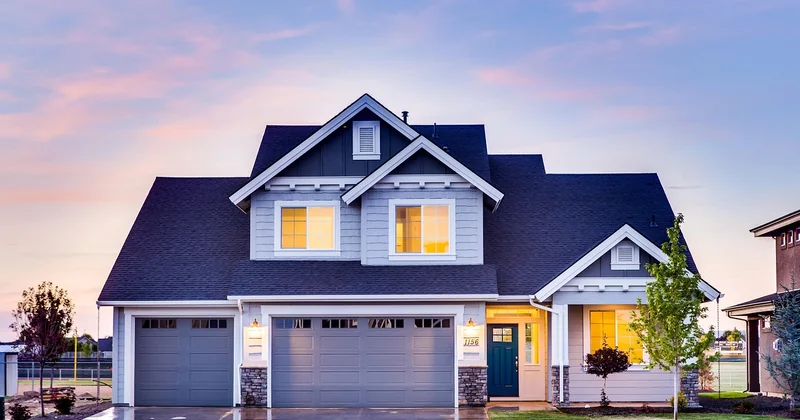
What is the 7% rule in real estate?
The 7% rule is a rough guideline for transaction costs. It suggests you should budget around 7% of a property's value to cover the costs of buying and later selling—things like agent commissions, closing fees, and related expenses. The idea is simple: if you might sell within a few years, that 7% can eat your gains, so you'd better plan to hold long enough for appreciation to outrun it.
In a remote-work market, this rule gets sharper. Buyers who relocate on a whim because "I can work from anywhere" often forget that "anywhere" can change again. I watched someone buy a house far out based on a fully-remote job, only to have the policy pull them back to three days in-office. They sold within eighteen months. The 7% went straight out the window.
What is the 3-3-3 rule in real estate?
The 3-3-3 rule is a buyer's checklist: a three-month supply of income, three months of mortgage payments saved up, and a credit score in the 300s—well, that last one is really just "a solid credit score," though the number gets quoted loosely. The spirit is about being financially prepared before you commit, with a cushion for the first three months of ownership.
For remote buyers, the cushion matters more, not less. If your income depends on a location policy that could shift, three months of breathing room is the difference between a smooth move and a forced sale.
What are the top three trends in the real estate industry?
If I had to name the three biggest forces right now, I'd put it this way:

- The hybrid commute premium. Towns with a tolerable link to a major job center are outperforming those without one—but only when the office requirement stays low.
- The home office as a structural feature. Floor plans are being rethought. Builders are adding dedicated workrooms. Resale value now rewards them.
- Digital-first transactions. Virtual tours, remote closings, and online document handling went from novelty to expectation. They didn't replace agents—they changed what agents do.
| Trend | What it means for suburban demand | Who it affects most |
|---|---|---|
| Hybrid commute premium | Buyers stretch their radius when office days drop | Towns with weak transit links |
| Home office demand | Larger homes and extra rooms command more | Small apartments and starter homes |
| Digital-first buying | Remote buyers compete from farther away | Local buyers facing out-of-town offers |
Read that table again, and notice how the trends reinforce each other. A buyer who can tour remotely, work remotely, and only commute occasionally has every reason to look two towns further out. The competition for the suburbs closest to the city gets stiffer, and the outer ring gets rediscovered.
Is real estate going to be taken over by AI?
No. Not entirely. But it's already reshaping how the work gets done.
AI can estimate a price, sift a listing database, schedule a showing, and draft the paperwork faster than any person. What it can't do is stand in a kitchen and tell you the light is wrong in winter, or feel that a neighborhood is quieter at night than it looks on a map.
Where I've seen AI genuinely help: pulling comparable sales in seconds, flagging properties that match odd criteria, handling the administrative slog. Where it falls flat: reading a seller's hesitation, or catching the thing an inspection report buries on page nine. Those still need a human who's walked the street.
My honest take? AI trims the busywork and raises the bar for what an agent should be doing. It doesn't replace judgment. If anything, it makes judgment the only thing left to sell.
The far end of the yard
Here's what I keep coming back to. When Marc and Hélène bought that house forty minutes out, they weren't chasing a trend. They were buying something specific: a room with a door they could close, and a commute they could live with once a week.
The suburbs that win over the next few years won't be the ones closest to the city. They'll be the ones that understand their buyers now spend their whole day there—working, walking, living. The town that treats a Tuesday like a Saturday is the town that keeps its new residents.
The numbers will keep shifting, the office policies will keep wobbling, and someone will always quote you the 7% rule like it's scripture. But the underlying question hasn't changed since that couple signed their papers: does this place work for the life you actually live? Get that answer right, and the commute—however long it is—takes care of itself.